Apparently, soba is very good for you.
People say it has a low glycemic index,
contains plenty of B vitamins,
and includes a type of polyphenol called rutin.
I’ve also heard it’s good for your skin and helpful for dieting.
Little by little, soba has been becoming a more noticeable and attractive Japanese ingredient in my life.
And yet, honestly, I never used to cook soba very often myself.
For somen noodles, I already have my favorite brand.
For udon, frozen udon is my standard choice.
In my mind, those noodles already had a clear “this is the one” feeling.
But soba always felt a little more complicated.
There are too many kinds at the store —
100% buckwheat, 80/20 blends, dried noodles, fresh noodles…
Somehow, soba felt slightly like food for experts.
And because of that, I usually left it sitting on the shelf untouched.
The reason I suddenly became interested in soba was because I heard someone say:
“Soba is delicious with olive oil and Parmesan cheese.”
Something about it sounded simple, western, and oddly elegant —
like something a stylish model would casually eat for lunch.
It reminded me that one of my favorite cooks, Yoko Arimoto, once introduced a way of eating soba with olive oil, salt, and freshly grated wasabi.
I had always been intrigued by that idea too,
but somehow it felt so minimal and refined that it intimidated me a little.
But the moment I heard “Parmesan cheese,” something changed.
Honestly, what I really dream of using isn’t powdered Parmesan at all.
I want a real block of Parmigiano Reggiano sitting in the kitchen,
alongside a cheese grater,
so I can shave off little pieces whenever I cook.
I’ve slowly but surely started longing for that kind of life.
“Maybe someday that could become part of my everyday routine too.”
Thinking about that while grating cheese over soba somehow made me smile.
And besides, there’s always that half-forgotten container of grated Parmesan sitting in the refrigerator.
“Oh… this is finally its moment.”
The thought made me want to try it immediately.
And honestly, if you don’t know which soba to buy, maybe you should just try one.
Then another one.
And slowly discover the kind you love.
That thought suddenly made soba feel much more approachable.
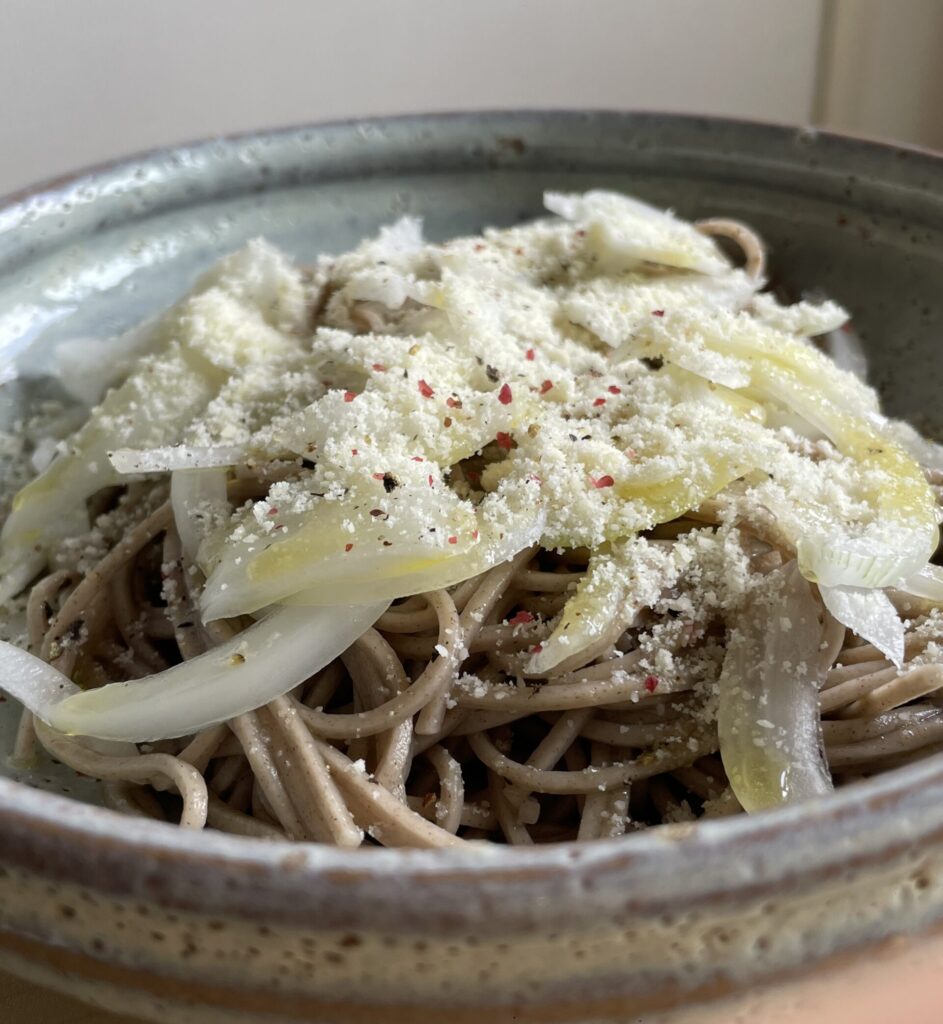
I cooked the soba, rinsed it in cold water,
then added olive oil, Parmesan cheese, and a little good salt.
On top of that went thin slices of fresh new onion.
And then, completely on impulse, I added some shredded nori seaweed too.
It was so good.
The gentle saltiness of the cheese and salt.
The fragrance of olive oil.
The freshness of the onion.
The flavor of the seaweed.
It somehow made me feel like I was eating something truly good.
Not “luxurious” good.
More like…
something my body would quietly thank me for.
Something that felt light and nourishing.
Delicious, but not heavy.
For my second helping, I tossed the freshly boiled hot soba immediately with olive oil, Parmesan cheese, and salt.
Then I added even more cheese right before eating.
The leftover onion and nori went in too.
This version was richer.
The cheese melted slightly into the noodles, mixing with the olive oil in a way that almost reminded me of creamy cod roe pasta.
Even after eating two servings, I felt comfortably full without the heaviness I usually feel after pasta.
If anything, it felt like my body would probably thank me later.
That feeling only made me love soba more.
Lately, even on days when I think,
“I want pasta,”
I also end up thinking about digestion and constipation.
So this might become the beginning of bringing soba more naturally into our everyday life.
Even when the refrigerator feels empty,
olive oil and salt are enough to make it delicious.
Cheese makes it even better.
Egg yolk.
Nori.
Salted kelp.
Wasabi.
All those little leftover ingredients sitting quietly in the refrigerator suddenly feel like they could shine because of soba.
I think soba was always much more casual and free than I realized.
And if you happen to have Parmigiano Reggiano in your refrigerator,
I truly hope you’ll try it this way someday.
📖 Our Recipe Book
For those who enjoy spending quiet time in the kitchen,
we’ve gathered some of our favorite everyday recipes here.