I like tamagoyaki.
It has always been a familiar part of my life, and it may even have been the very first thing I ever learned to cook.
After all, if you have eggs, you can make tamagoyaki.
It’s exactly what its name suggests—a very simple dish.
But I think tamagoyaki is one of the most fascinating foods there is.
Because no two tamagoyaki are quite the same.
Every family has its own version.
I remember trading side dishes with my friends during lunch when I was in elementary school.
One day, I tried a friend’s tamagoyaki and was surprised.
It was very sweet.
My mother’s tamagoyaki was slightly sweet too, but it also had the gentle flavor of dashi and a touch of salt.
If I had to describe it in one word, I would call it kind.
My friend’s mother’s version was different.
The sweetness came first and stayed there proudly.
It almost tasted like a dessert.
And yet, I liked it.
I remember thinking,
“Oh, tamagoyaki can taste like this too.”
Since then, I’ve felt that there are as many kinds of tamagoyaki as there are families.
The tamagoyaki at a sushi restaurant.
The tamagoyaki sold at a local deli.
Each one seems to carry the preferences and habits of the person who makes it.
Whenever I see tamagoyaki somewhere, I can’t help tasting it carefully and comparing it to others.
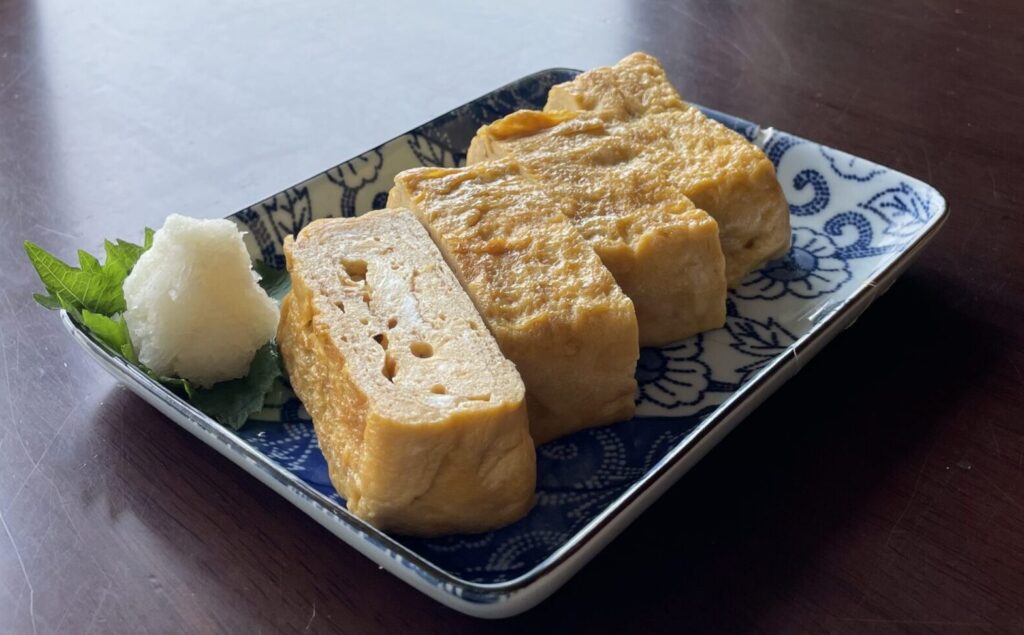
I love the way it looks, too.
Its color is yellow.
But not the bright yellow of a traffic light.
It’s a warm yellow.
Sometimes there are little browned spots from the pan.
Sometimes streaks of egg white create soft marbled patterns.
Even the cross-section is charming.
And I love watching the steam rise from a freshly cooked tamagoyaki.
For some reason, that steam always feels at home in a quiet morning kitchen.
Tamagoyaki changes a little every time you make it.
The way it’s rolled.
The heat of the pan.
The amount of dashi.
Just as I feel slightly different from day to day, tamagoyaki seems to have different moods too.
But I like all of them.
One bite of tamagoyaki always makes me relax.
It softens my face into a smile.
And sometimes I find myself thinking,
“Ah, so this is today’s tamagoyaki.”
I often make juicy tamagoyaki filled with plenty of dashi.
But I also love soft and fluffy ones.
And I love the ones that have cooled down and become slightly denser, with all their flavor concentrated inside.
Most of all, though, I love my mother’s tamagoyaki.
There is something airy about it.
Light.
Gentle.
I’ve tried to recreate it several times, but I never quite succeed.
Whenever I ask my mother how she does it, she always says,
“I don’t do anything special.”
And honestly, it looks that way.
Which somehow makes it even more mysterious.
She gets embarrassed when I point a camera at her.
To her, it’s nothing remarkable—just something she has been making with familiar hands for decades.
But to me, it’s special.
I think every family probably has a dish like that.
You know the ingredients.
You know the method.
And yet, somehow, it never tastes exactly the same when you make it yourself.
Maybe that’s why I love tamagoyaki.
It’s simple, yet surprisingly deep.
I could eat it every day and never get tired of it.
And somehow, every version carries the taste of the home it came from.
Simple things often turn out to be the deepest.
I think tamagoyaki was the first thing that taught me that.
📖 Our Recipe Book
For those who enjoy spending quiet time in the kitchen, we’ve gathered some of our favorite everyday recipes here.