
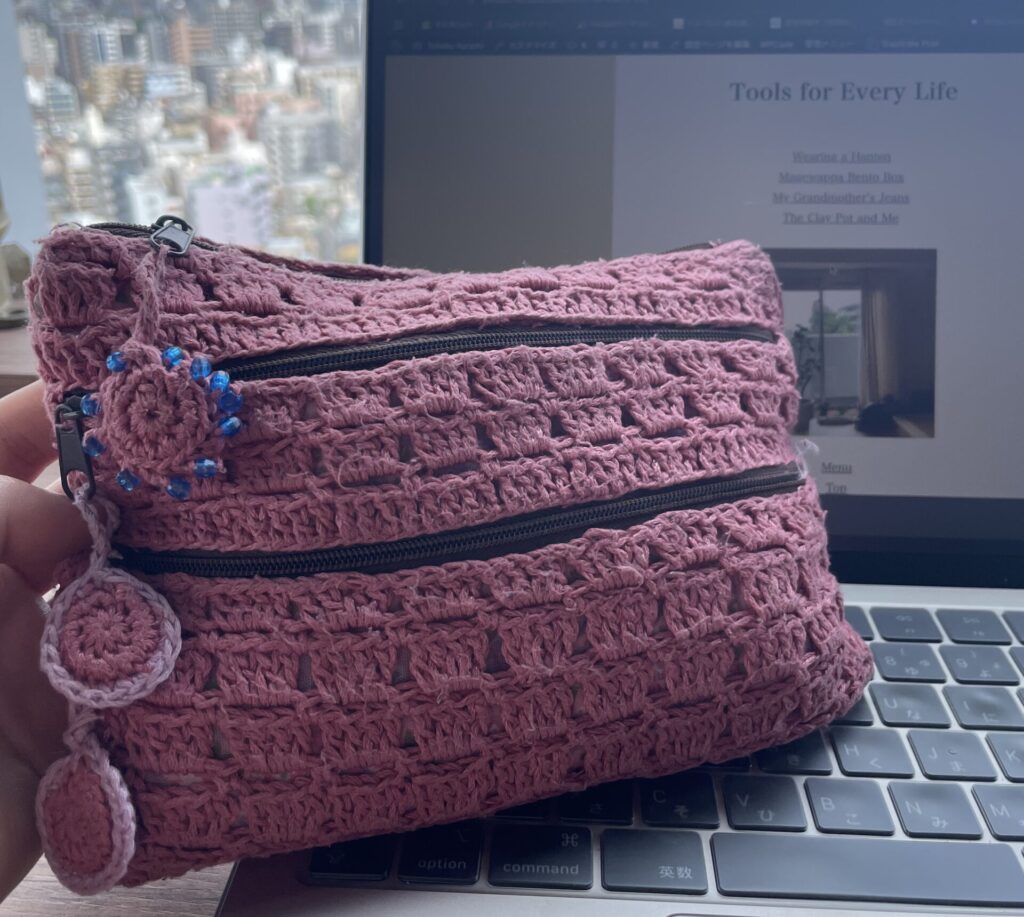
A woman I used to visit for work once gave me a handmade pouch.
It was a deep pink color, almost like Kawazu cherry blossoms, and I think it had been crocheted with embroidery thread.
It had three brown zippers, carefully attached in a way that felt not only beautiful, but practical too.
I received it about six years ago.
She was an elderly woman living in a two-generation home with her beloved son.
She had dementia.
Sometimes she would forget things, struggle to make it to the bathroom in time, or become upset by all the things she could no longer do the way she once had.
There were days when she cried from that frustration.
But even so, she always spoke with elegance.
Every time I visited, she welcomed me like a guest arriving at her home.
Apparently, she called me “her friend.”
Whenever I came by, she tried to prepare tea or snacks for me.
Even the mugs and dishes she used carried the feeling of having been carefully chosen and treasured over many years.
Now, people around her would say things like,
“Don’t use fire anymore because it’s dangerous.”
“Don’t use those dishes because they might break.”
Little by little, more parts of her daily life were becoming restricted.
But even then, I could still feel that she had spent her life slowly surrounding herself with things she truly loved.
I heard she had once been especially talented at calligraphy.
Talented enough to win awards.
But now, she rarely practiced anymore because realizing she could no longer write the way she once had felt painful to her.
She also loved knitting and dressing nicely.
At the time, I visited her home for the purpose of “maintaining and improving physical function.”
But after working in home nursing care, I started feeling that most of the struggles people carry cannot be solved through physical ability alone.
Her living room was on the second floor.
During the day, she stayed upstairs, while her bedroom and the bathroom were downstairs.
Every morning, she would properly change her clothes and make her way upstairs to spend the day there.
I wanted to help preserve that rhythm of life she had built over so many years.
And I felt that simply stretching her legs, practicing walking, and doing strength exercises was not enough.
Sometimes, the very structure of “the one receiving care” and “the one providing care” can quietly damage a person’s dignity.
Many elderly people feel guilty about needing help with everyday things.
But I think that no matter how old someone becomes — even with dementia —
the desire to help someone,
or to make someone happy,
never completely disappears.
I always tried to think of rehabilitation time not as “my time,” but as “their time.”
So rather than talking about myself, I tried to create space where the other person could begin speaking.
And when they did speak, I listened with genuine curiosity.
I never tried to hide the fact that I truly wanted to know who they were.
Technically, accepting gifts or food from clients was against company policy.
But when someone standing right in front of me genuinely wanted to offer something, or care for someone in return, I could never fully reject that feeling.
Of course, part of me was always thinking,
“I’ll probably get in trouble if someone finds out.”
But one thing that supported me was hearing from her family that,
“She’s always in a very good mood on the days you visit.”
Because, apparently,
“My friend is coming today.”
A friend who visited once a week.
She probably didn’t remember my name anymore.
But maybe she remembered my voice, my face, or the clothes I wore.
Sometimes she would say,
“I’ve been waiting for you.”
And one day, she gave me this pink pouch.
I imagine she had made many things like this over the years for her children and friends.
I also remember a beautifully handmade lap blanket she used — a soft color somewhere between pale green and light blue.
If I had seen the pouch by itself, honestly, it probably wouldn’t have been something I would have chosen for myself.
But I was so happy to receive it.
Saying it carries “her whole life” might sound dramatic, but I could feel something inside it — warmth, time, and the quiet history she had lived through.
And objects remain.
I’ve used that pouch ever since as a case for charging cables.
Without even realizing it, years passed.
I carry it with me almost every day.
Recently, I suddenly thought,
“I’ve really been using this for a long time.”
And whenever I look at it, I remember something else too.
There used to be a woman I often saw at a café I visited before work.
I had noticed her glancing at my pouch from time to time.
She looked like someone who might teach — or perhaps attend — classes for flower arranging, sewing, or some kind of handmade craft.
One morning, she sat beside me and asked,
“Did you make this pouch yourself?”
Her expression looked strangely happy, almost like she had found someone who shared the same hobby.
“Oh, no… it was actually a gift.”
I answered.
“I see. It’s lovely.”
That was all she said before we both quietly turned back toward our coffee.
I don’t know much about knitting or crochet.
But afterward, I found myself wondering:
Maybe this was the kind of stitching that quietly catches the eye of someone who understands these things.
Because she had been very skilled at knitting.
I think she must have spent many years making things carefully with her hands.
And even now, I still carry this pink pouch with me.
And sometimes, in small unexpected moments, I remember her smile and her warmth again.