Lately, baking with rice flour has become much more a part of my everyday life than it used to be.
But honestly, baking with rice flour rarely goes exactly the way I imagine.
If I simply followed recipes as they are written, using wheat flour would probably be much easier.
The rise, the texture, the structure — everything tends to be more reliable.
And yet, I stubbornly keep baking with rice flour.
Which means there are plenty of failures too.
Sometimes I imagine something crisp or fluffy,
only for it to turn into something dense and chewy like mochi.
There are many moments when the texture ends up completely different from what I hoped for, and I feel disappointed.
Moriyan often tells me,
“Well… if you think of it as a completely different dessert, it’s actually pretty good.”
Still, among all those experiments, these kinako cookies were special.
The moment I tasted one, I immediately smiled and thought,
“Oh… this is delicious.”
And unusually for me, it became something I genuinely wanted to make again and again.
Kinako itself was always something I occasionally bought at the supermarket.
But honestly, it usually only appeared around New Year’s when eating mochi.
I knew soybeans — the ingredient kinako is made from — were supposed to be healthy,
and apparently good for digestion too.
So I would buy it because of those things I had read somewhere,
sprinkle it over yogurt or granola for a while,
and before long, it would quietly settle itself in the back of the refrigerator.
That was the kind of ingredient it used to be for me.
But after starting Sushi Couple,
I slowly began becoming more interested in Japanese ingredients.
Rice flour.
Miso.
Kinako.
Things that had always been so ordinary to me that I had barely thought about them before.
But once I started imagining how fun it might be to bake sweets using Japanese ingredients,
kinako slowly began taking up more space in my mind.
And somehow, this cookie was born from that feeling.
The recipe itself is incredibly simple.
Mix, roll, bake.
For someone clumsy and a little absent-minded like me,
this kind of easy baking feels just right.
I personally prefer using raw cane sugar or wasanbon instead of white sugar.
I feel like their softer sweetness matches the gentle flavor of kinako much better.
And then there’s the sesame.
Lots of it.
Especially ground sesame.
The aroma becomes much richer,
and every now and then, a tiny sesame seed remains whole, creating a little surprise when you bite into it.
These cookies are simple to make,
but eating them requires a little caution.
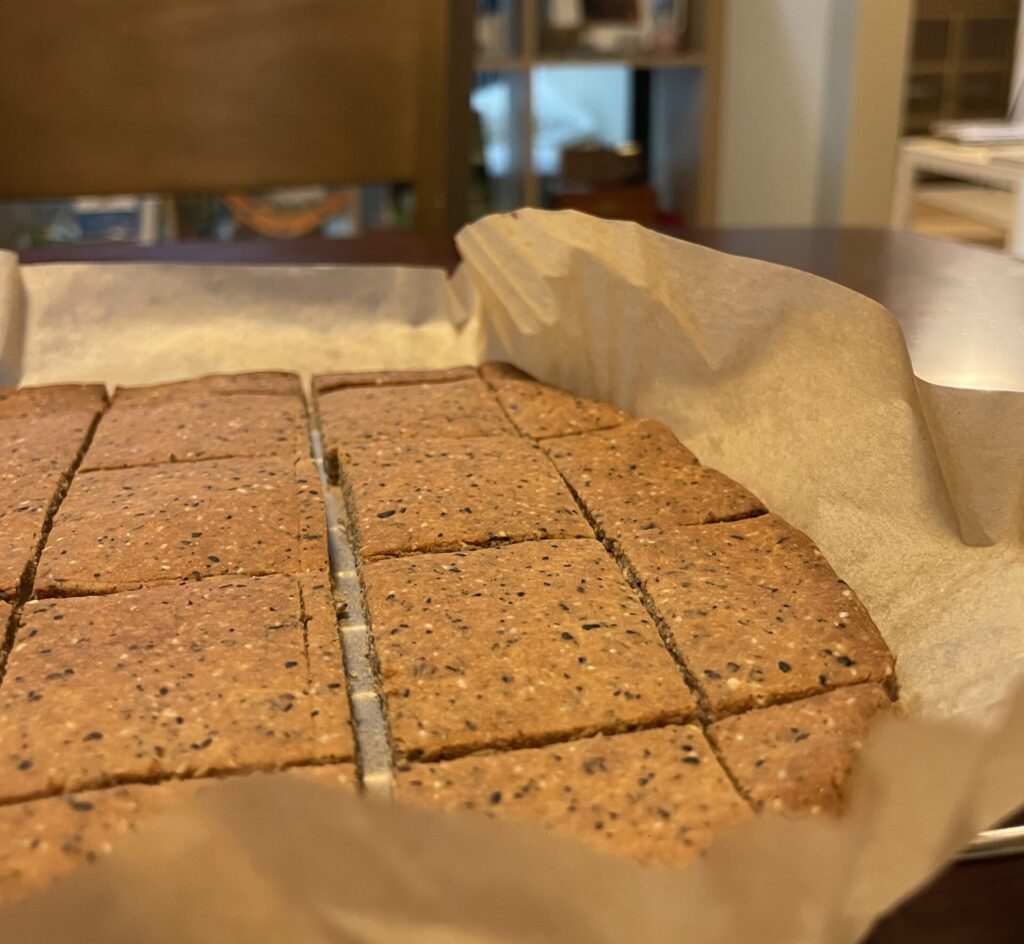
Because they are extremely crisp and delicate.
The moment you bite into one, it crumbles apart so easily.
So I usually tilt my head upward slightly while eating them, trying not to let the crumbs fall everywhere.
Maybe if I become more skilled someday,
I’ll be able to create different textures — crunchier ones, firmer ones, and so on.
But for now, I still don’t have that kind of technique.
And honestly, I’ve grown quite fond of this slightly fragile, crumbly texture.
These are not rich, indulgent cookies filled with butter and heavy cream.
But the toasted aroma of kinako and sesame,
along with the softness that soy milk and rice oil seem to bring,
makes me feel something I really love:
“They’re sweet and delicious, but somehow they also feel gentle on my body.”
As I keep eating them,
I always find myself wanting a cold glass of milk.
Though of course, they pair beautifully with tea too.
Recipe Memo
【Ingredients】
- 70g rice flour
- 30g kinako (roasted soybean flour)
- 2 pinches of salt
【Instructions】
- In a bowl, mix rice flour, kinako, and salt well.
- In another bowl, mix sugar, oil, and black sesame until smooth.
- Add the wet mixture into the dry ingredients and mix until fully combined.
- Place the dough on parchment paper and roll it out evenly (about 5–6 mm thick).
- Trim the edges and cut into your preferred size.
- Bake in a preheated oven at 180°C (350°F) for 10–12 minutes, until lightly golden.
If the dough feels too crumbly to come together,
I usually add a little more soy milk or rice oil while watching the texture carefully.
The salt is optional, but I personally love the occasional little salty bite when eating them.
📖 Our Recipe Book
For those who enjoy spending quiet time in the kitchen,
we’ve gathered some of our favorite everyday recipes here.